Total Pageviews

Wednesday, May 18, 2011

The Golden Triangle

There is an area where three countries meet: Thailand, Myanmar (used to be called Burma), and Laos which is called the Golden Triangle.  It is about three hours north of where we are in Chiang Mai and we couldn't pass up taking a day trip there.  

     Opium Field
It got its name as a result of the opium trade which took place here.  Opium was first grown in northern Thailand in the late 19th century by hill tribes who had moved in from China.  Opium grows on poor soil in high altitudes and it was a very profitable cash crop for the hill tribes. By 1959, Thailand had outlawed the cultivation of opium, and encouraged crop replacement with cabbages, coffee, and tea.  This was a successful replacement program, cutting the growth of opium by 80%.  A few Thai hill tribes still secretly grow opium.  Myanmar doesn't have a replacement program and it is the second largest grower of illegal opium (after Afghanistan) in the world today.  That opium filters down into Thailand and the Thai government sets up road checkpoints to try to stop the influx of the drug.

                                                                                                                                                                                                                                                      
The term "Golden Triangle" refers to the method of trade for the opium.  It was traded ounce for ounce with gold on a triangular strip of land in the middle of the Mekong river which borders all three countries.  No one country owns that land-it's called, "No Man's Land."


 We passed "No Man's Land" when we took a boat trip up the Mekong, into Laos. We also found out the origin of the term, "Slow boat to China."  It takes two days for cargo boats headed to China to get from the mouth of the Mekong in Viet Nam up to their destination in China.


Al getting off our river ferry in Laos


 It is the world's 10th longest river and the 7th-longest in Asia. Its estimated length 4,909 km or 3,050 miles from the Tibetan plateau this river runs through China's Yunnan province, Burma, Loas, Thailand, Cambodia and Vietnam  It was very cool to be on the Mekong River, which played such a big part in the Viet Nam war.

We got off our river ferry in Laos.  What a sad place.  Very poor.  Their one big tourist attraction is they sell bottles of whiskey which contain snakes, or scorpions, or tiger penises.  It was sad, and gross.  We felt dirty that we were a part of this pathetic attempt to attract tourist dollars.


Laos hut selling tourist junk

Snakes bottled in whiskey and sold to tourists


Then we drove to the Burmese border.  There is a small Thai village market right at the border with Myanmar.  All the stalls sell goods imported from China.  The packages were all in Chinese, but they did have some knock-offs. 


Browsing the knock-off watches

 We attempted to haggle.  When a shopper shows interest in something, the seller punches in a number onto a calculator and shows that to the buyer.  The buyer obviously says, "Too expensive", and the seller punches in their discount.  When the buyer still waffles, the buyer is then encouraged to key in their price into the calculator.  Well, I did this and apparently, my number was an insult because the seller ripped the calculator from my hands in disgust.  Oops.  I guess no sale today.

Myanmar border

Saturday, May 14, 2011

Thai Cooking School

Today, Saturday May 14, we went to a cooking school and learned how to make a plethora of Thai dishes.  Thai food is fresh and flavourful and spicy.  All Thai food strikes a balance between the four flavours: sweet, sour, salty and hot. A typical Thai meal consists of soup, a curry, a stir fry and a spicy Thai salad, and we made, and ate, them all.

Our chef, Permpoon Nabnian, picked us up from our hotel at 8:45.  We were the first and he told us that there would be seven people in total.  Next, we stopped at a hostel where a young American couple (Jessica and Kevin) and a good Canadian boy (Rhema from North York) hopped into the back of the truck with us.  Lastly, we picked up two Taiwanese guys, Eddie and Dennis. 
We all went to the market where Perm showed us what to look for and buy.  We learned that it is better to buy smaller eggs because they have more flavour.  Big eggs come from older hens and aren't as tasty. 
Fully stocked, we climbed back into his converted pick up (benches along the sides) and drove to his open-air kitchen/school.


Perm, at the market, showing us what to buy


We learned so much and words won't do the food justice.  We can't wait to get home and cook for you.

The video is a must see.  We will not be cooking like this at home!


Open-air kitchen


Al wins the prize for best tomato flower


Perm gives Kim's dish a taste test.


New friends sharing our dishes

Mae Taeng Elephant Camp

Elephants have both a religious and economic importance in Thailand.  They are mentioned in Buddhist writing from centuries ago and they have a higher status than any other animal.  White elephants are particularly important and only the king can own them. 
Elephants have been used for logging for centuries.  Although most logging is officially banned in Thailand, elephants are still used for transporting logs in some areas.  They are often looked after by one handler for life, and they cause less damage than machinery.
Wild elephants still roam Thailand but deforestation and poaching have reduced elephant numbers to a few thousand.  Elephant camps have been established to protect elephants and to educate the public.

One of the most popular tourist destinations up here in Northern Thailand is the Mae Taeng Elephant Camp. At this camp rescued elephants are well-fed and housed and their numbers are on the rise.

Elephant's trunks are nimble-this one is putting a hat on Kim's head


Of course, they have to work for their food and board. The elephants put on a show-they kick around a soccer ball, dance to music, bathe in the river, demonstrate some of the old jobs they used to do (roll logs into position, drag logs around), paint pictures, and take sweaty tourists for rides.


A natural roller coaster ride


When elephants walk, they lumber. Up on its back that lumber becomes a jolting, rolling ride. We sat perched on a chair-like contraption on the elephant's back, while the driver sat on its neck and used his legs to steer it. Our driver steered our elephant into the river, and back up some steep inclines. About halfway through our ride our driver popped a folded green leafy thing into his mouth. As he chewed, he became much more animated, singing and urging our elephant to go faster. We think he was high.


Our elephant ride ended at a little village, where we got in an ox cart for the return trip. A boy about 12 years old was our driver. Ox carts provide a marginally smoother ride than elephants.


Rare white water buffalo pulling an ox cart


After the buffet lunch provided by the camp we enjoyed a bamboo raft trip down the river.

We had to work for our ride


Then we stopped at a orchid farm. Orchids are gorgeous.

Thursday, May 12, 2011

A full day in Chiang Mai

Chiang Mai is Thailand's second largest city (after Bangkok) with a population of almost one million.  Within the city there are 350 temples-the most per capita in Thailand. 
We hired a car and driver and visited the biggest, highest and most revered Buddhist shrine in northern Thailand-Doi Suthep.  This temple is high up in the mountains which border the city.  Very scenic. We can see it from our hotel room.
There are 350 steps up, and 350 steps down.  This rivals the steps we had to take down from the 24th floor during the hotel fire drill. We anticipate leg pain tomorrow.

Al, near the bottom of the stairway

Intricate scales on the dragon at the temple

Doi Suthep Temple

Buddha in the temple


 Monks are well-respected and in the social hierarchy they rank just below royalty.  Monks are prohibited from touching women, and they can't receive anything directly from a woman, either.

Our driver took us to three factories-silk, silver and leather.  All the tours were very interesting. 
 We saw how the workers combine 92.5% pure silver with 7.5% pure copper to make silver for jewelry.  Then we watched how they make moulds for silver jewelry, and cast the silver into the mould.

Silver technician
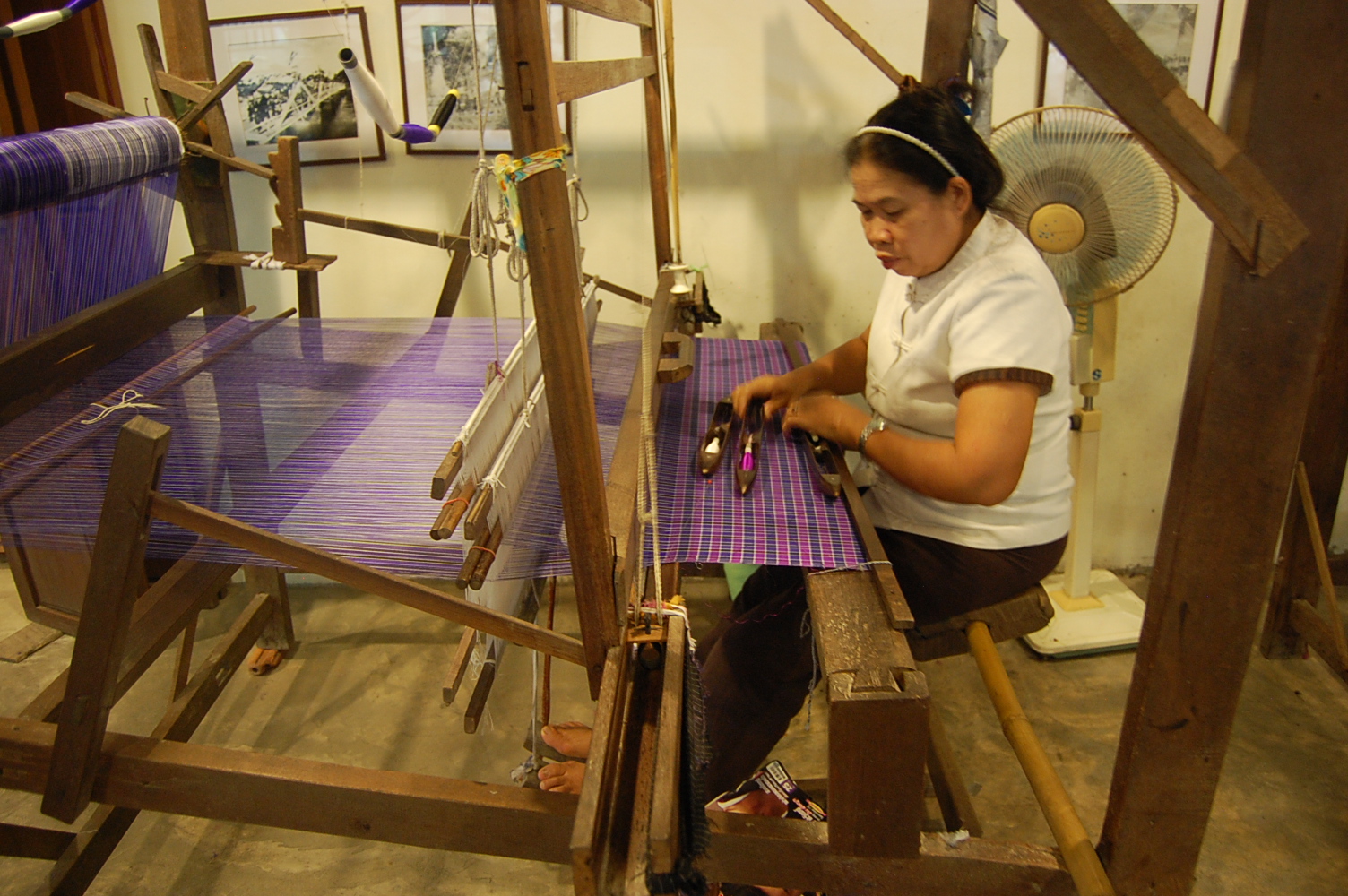
 At the silk factory we saw moths laying eggs, the eggs turning into worms, worms eating mulberry leaves and growing very large, then spinning silk into a cocoon.  Then the silk factory boils the cocoons and harvests the silk.  The finished silk cloth was dyed into a multitude of colours, all very vibrant.  This factory also sold silk clothing, and they would make to order.


Worker weaving silk cloth

Worms spinning into cocoons
Silk products


Finally, we toured the leather factory.  There, they make leather products out of not only cow and sheep hide but also elephant, alligator and stingray.  These last three made up into exotic looking wallets and handbags-with a price tag to match.

Stingray leather-made only from the centre strip of the stingray's back


Our hotel offers a buffet lunch and since we were pinched for time we opted to eat here.  Excellent choice.  The buffet has Thai dishes and they are tasty.  From spicy soups to noodle dishes to curries-all so yummy.  There is a selection of fresh fruits-mostly melons and dragon fruit, for dessert. 

Thai people use a fork to push food on to a spoon and they eat with the spoon
Since lunch was so outstanding we had dinner at another restaurant here at the hotel.  There was a wide selection on the menu, and we didn't know how big the portions were because everything was so cheap.  We asked our server if the size was big or little.  His English was limited.  We think he said the portions were small.  We ordered a soup, two appetizers and two main courses.  The portions were not small-they were enormous.
Here's the load of food we received

Stellar city view during dinner
The restaurant staff really tries hard to please, even with limited English.  Al ordered a Bailey's with his coffee after dinner.  The server questioned Al to make sure he understood what Al wanted.  He still seemed puzzled when he left our table.  We saw our server talking to another server.  Shortly a small dish was delivered to the table-it contained bay leaves, not Bailey's. 

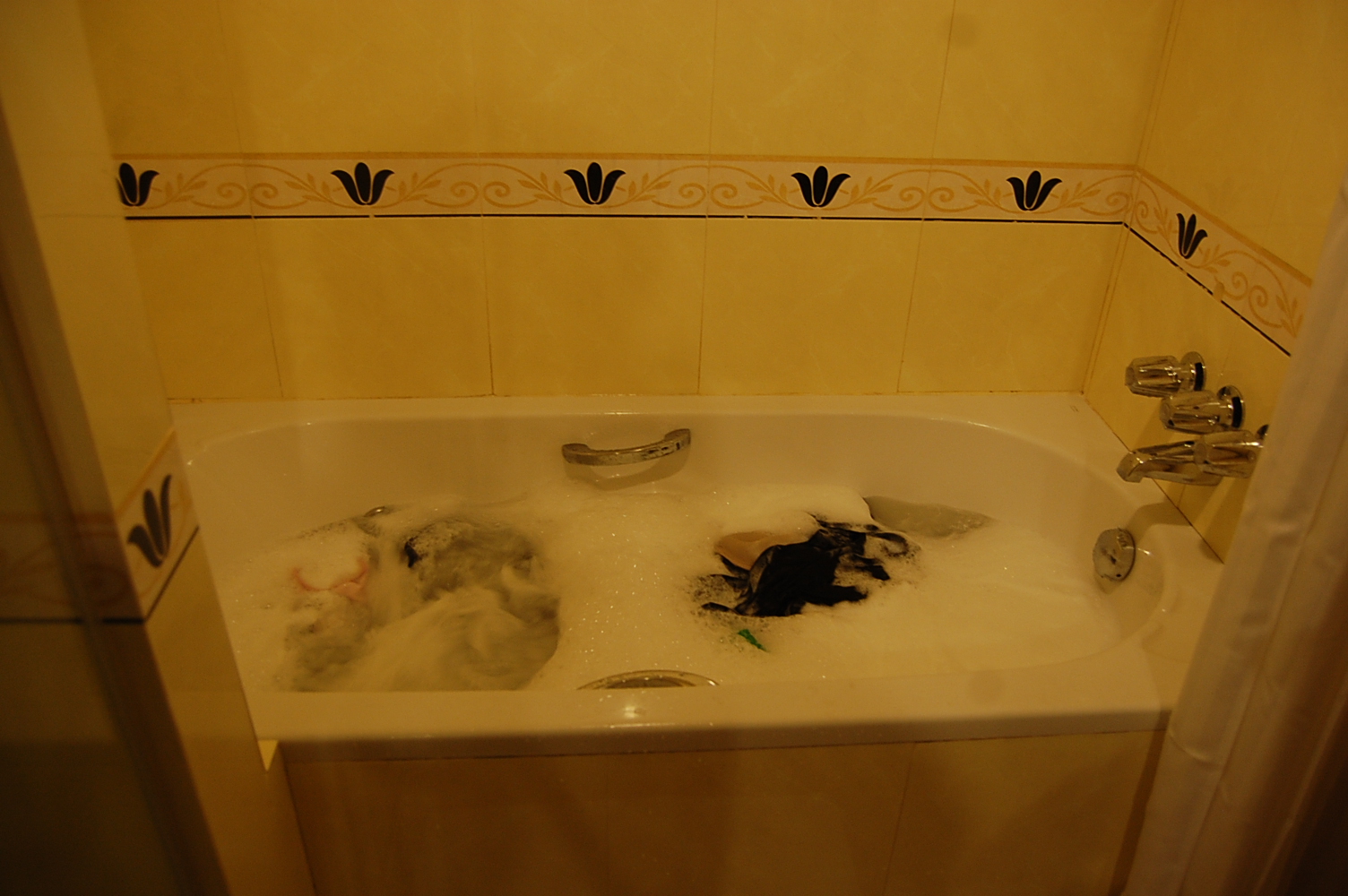
Guess what we did in the whirlpool tub this afternoon?  Yup-laundry.  We started to wash out some clothes when Al noticed the tub had jets.  We filled it up, added soap and turned on the jets.  Take that Maytag.
Our new washing machine

Wednesday, May 11, 2011

Night train north to Chiang Mai


We did some on line research of train routes, fares and times.  This web site really helped - .www.seat61.com/Thailand.htm.  Here is a sample of the charts that give you times and stops.

 Chiang Mai ► Bangkok

Train number: 106 112 102 12 * 52 14 * 2 * 10
Classes: 2,3 2,3 2,3 DRC S,s,2,3 1,S,R 1,S,R DRC
 Chiang Mai depart:
-
-
06:45 08:45 14:50 16:30 17:55 21:00
 Lamphun  arrive/depart - - 07:14
09:13
15:13 16:54
18:18
21:18
 Phitsanulok  arrive/depart 08:59 10:18 14:15
15:08
22:40 00:05
|
03:51
 Lopburi arrive/depart 12:27 14:48 17:47
18:05
02:50 03:32
04:04
06:30
 Ayutthaya arrive: 13:28 16:05 19:14
18:53
03:49 04:40
05:13
07:21
 Don Muang arrive: 14:13 17:03 20:09 19:27 04:39 05:36 06:04 08:04
 Bangkok (Hualamphong) arrive: 15:05 18:00 21:10 20:25 05:30 06:40 07:00 09:10

With the distance and time involve we opted for the 1st Class sleeper at the price of $40 each.  It was well worth the cost.

 Fares


1st class sleeper 
a/c express train 
2nd class sleeper 
a/c express train
2nd class seat
a/c fast railcar 
2nd class seat
ordinary train
3rd class seat
ordinary train
Bangkok to Chiang Mai
(751 km)
1,453 (£29, $40) 881 (£18, $25) 611 (£12, $17) 431 (£9, $12) 271 (£5, $8)


Train travel in Thailand is a convenient way to travel.  A taxi to the train station is cheap and quick.  There's no security checkpoint, just jump right on the train.  The overnight train from Bangkok to Chaing Mai travels 700 kms and takes 14 hours.  Yes, that's 50 kms per hour.  Certainly not the bullet train here.  We were racing mopeds.

Bangkok train station

Our train car
There were 13 cars on this train.  Some were seats that reclined.  They were obviously the cheapest ($12) but the least comfortable-probably comparable to an airplane seat.  Next, second class compartments were for four people and they had a curtain for privacy.  We paid for first class, good thing because our two-person cabin came with a lockable door, sink and large upper and lower berths. 


Al, reclining in comfort with a nightcap

The next morning, well-rested


We thought we got our own private bathroom in a first class cabin.  We didn't.  We had to share with the other 22 people in the car.  Al went first to use it and when he came back he told me it wasn't too smelly and that it was at the end of the hall.  I went down the aisle and saw a door that said PUSH, so I did.
I found the Asian version of the toilet. 


A tricky toilet even when you're not on a moving vehicle.  I didn't use it.  I scurried back to the cabin, evaluating my options (really, thinking how can I not go for 14 more hours).  Al assured me he saw a toilet with a seat.  I looked at him like he had two heads because I only saw the hole in the floor.  I was wondering if there was some apparatus I had to set up, or a rope to hold.  Then we both figured out there were two styles of toilets-eastern and western, and the western (complete with seat and a shower if you could stand to be in it that long) was around the corner.


The train ride itself  is not smooth.  Al equated it to being dragged through the forest on the back of a trailer. The track gauge is narrow so you feel the side to side and up and down movement.  We were the last car of the train so we're not sure if that makes a difference.  The motion does lull you to sleep.  We had a great night's sleep.  So did our cabin boy.  He was passed out on the floor of the hallway.


All of the small train stations along the route were beautifully landscaped and well maintained.


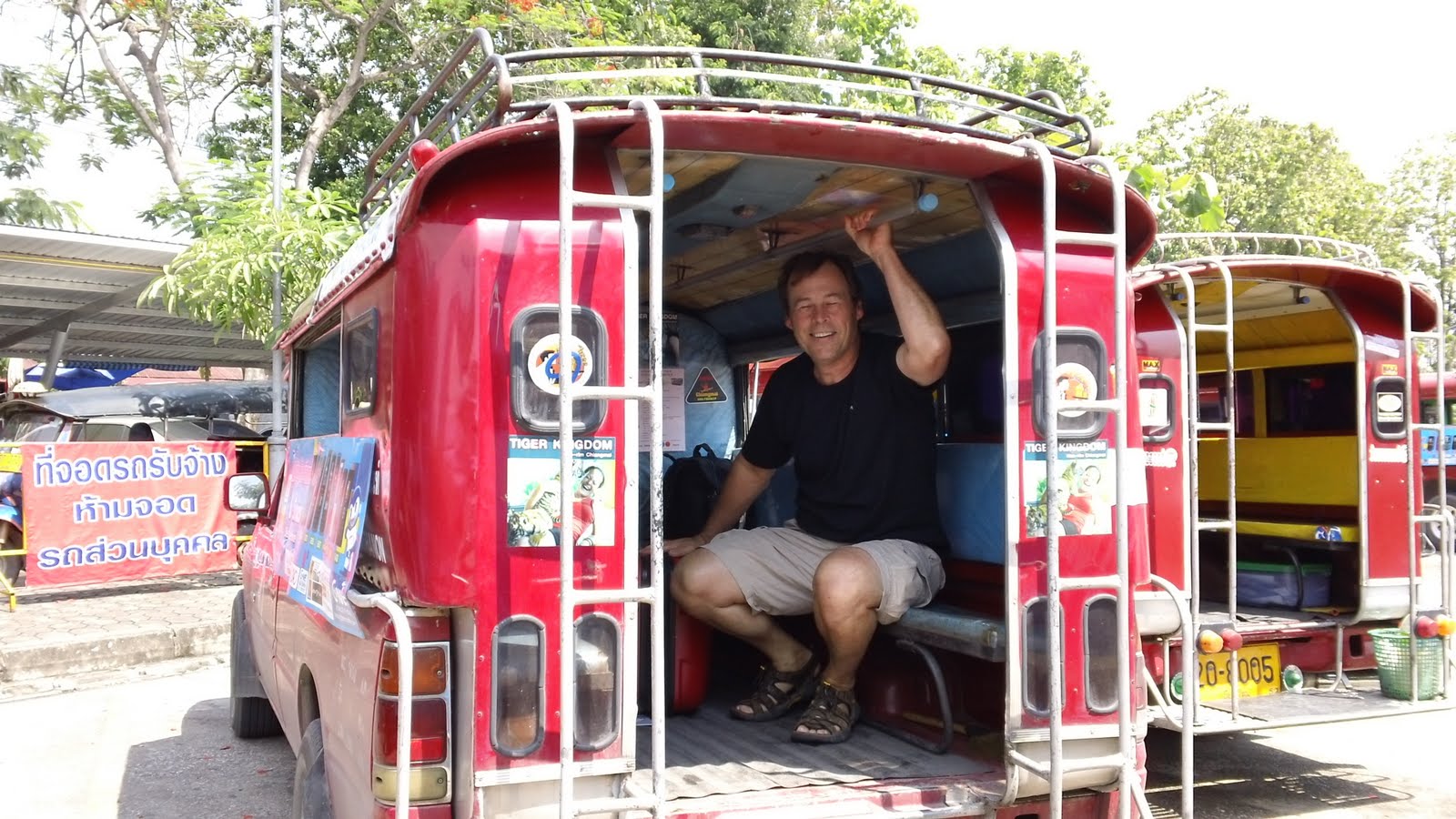
 We rolled into Chiang Mai station and disembarked with an army of backpackers from all over the world.  Inside the station, it was just like on the TV show Pilot Guides.  There were many locals hawking cheap hotels and hostels which would appeal to the backpackers.  There weren't any taxi drivers inside the station.  We don't think they are allowed inside but once we got to the open air entrance they were lined up like barking dogs along an electric fence. They were all yelling, "Taxi, you want taxi?"  We thought taxi meant a 4 door car with a trunk.  Nope, not here.  In Chiang Mai they have TukTuks and songthaews, which translates as two rows.  These are all red Toyota pick up trucks. These trucks have been fitted with benches which run from front to back along the sides of the truck bed.  There is a roof and sides (with open windows) and the back is open.


Songthaew we took to the hotel
Check this out, Brad

The songthaew deposited us at the Furama hotel.  Our room is nice.  It's decorated Thai style.  The bed is a mattress perched on a wooden platform and it is the hardest mattress ever.  Al checked to make sure it really was a mattress and not just the box spring.  Now we know why Thai massage is so popular here.


Our room is equipped with a small kitchen including a fridge, and we needed to stock it.  The Thai beer, Singha, is tasty.  We spied a 7-11 and headed out.  It was 2:30 in the afternoon and hot and humid.  Inside the 7-11 the A/C was a welcome blast of cool  and the beverage fridges were fully stocked, and locked!  We both looked at the padlock and groaned.  Of course, as we learned the hard way in  Bangkok, beer isn't sold between 2-5 pm.  So sad :(

We went to the Night Market and there were a plethora of Thai massage options and no red light district.  There was lots of shopping-knock off watches and jewelry and also handicrafts from the Hill Tribes.  It's also very clean and nobody hassles shoppers.

This morning, we both woke up very well rested despite the firmness of the bed (and we're being kind when we say firm).